
OMNI-CHANNEL
If you are looking for an OMNI-Channel solution to bring together on-premise casino, online gaming operations and hospitality (Food & Beverage, Hotel..) you should read the article below.
The only pattern which has proven to offer a truly seamless solution has been in a few very large organisations who have spent significant sums of money to implement an abstracted middleware solution, then move relevant functionality (marketing, CRM, compliance) to this core area instead of doing it many times in many platforms which just doesn’t work.
UPT builds and sells Gaming platform technology and has a solution to this problem, but which can also be applied to B2B operators looking for a central solution to offer value added services (payments, marketing, compliance etc), and also to those operating in multiple jurisdictions/states – and looking for a travelling wallet solution.

OMNI BACKGROUND
As gaming operations have evolved, and with the legalisation of online gaming in many jurisdictions, the requirement to link on-premise/retail casino and sports betting operations with an online equivalent has become clear. However, how to define and then deliver a ‘seamless’ customer experience across channels and indeed involving other relevant areas such as Hospitality and Food & Beverage is less clear.
The starting point is at least two head ends - on-premise Casino Management System and online PAM:
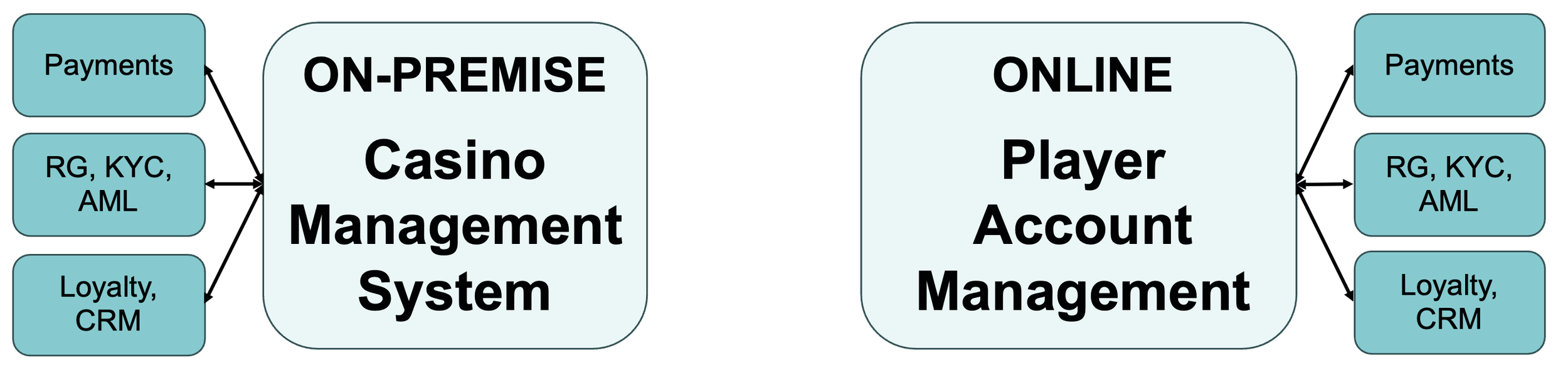
Typical responses to this challenge focus on 2 areas - the ability to register customers across channels and basic marketing, approached by:
Assimilation of all data into some form of data warehouse/lake
Try to do some basic marketing
Attempt to deliver cross-channel registration
Implement some form of global/single account
This is of course logical but does not look far enough down the path of delivering a truly seamless offering and unfortunately doesn’t recognise the blockers that exist.
Teams will look at the situation and usually pick one of the following approaches:
Create a ‘Dual-Master’ solution which ties both systems together via tight synchronisation.
Elevate one of the systems (either retail or online) to become an overall Master solution.
Implement a CRM type system to link both existing Master systems.
DUAL MASTER
By creating a system with very tight synchronisation, initial deliverables of joined up registration are usually delivered with relative comfort. Perhaps a few cross-channel marketing use-cases can be implemented.
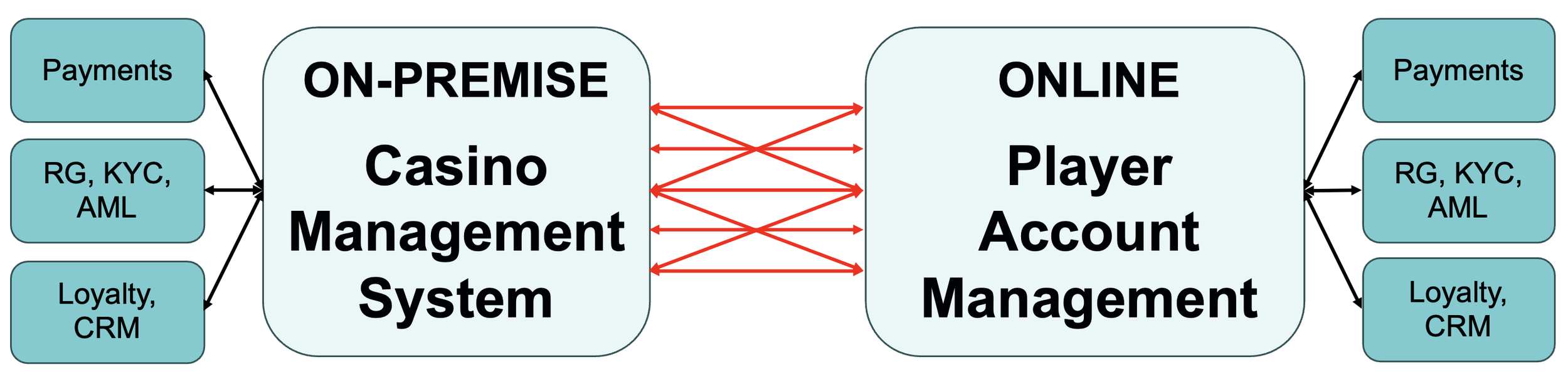
However, the design already creates a few fundamental problems -
Both Master systems are now doing something they were not designed to do when built, which logically means the effort will take longer, become increasingly tightly coupled, and be more expensive and higher risk than would otherwise be the case.
The synchronisation also must deal with establishing a single view of the customer, matching existing accounts in each system to a user, and dealing with any potential duplicate accounts. The logic contained in the synchronisation therefore expands rapidly.
Failure scenarios are very hard to deal with, as if one system is offline for any reason, or slows it impacts directly on the other. It also requires recovery and catchup functionality to be implemented.
3rd party tools which provide payments, KYC, AML, Compliance, CRM etc are linked into each Master directly and therefore do not ‘join the dots’ on customer activity. Any use-case trying to create a single view must therefore interact with multiple systems, and the spider-web of integration and complexity grows exponentially. One can only imagine the complexity in this scenario of trying to provide a seamless wallet across channels, or compliance use-cases.
ELEVATE ONE TO BE MASTER
One system may be elevated, becoming the overall OMNI Master, and being the system which will maintain a single view of the customer.
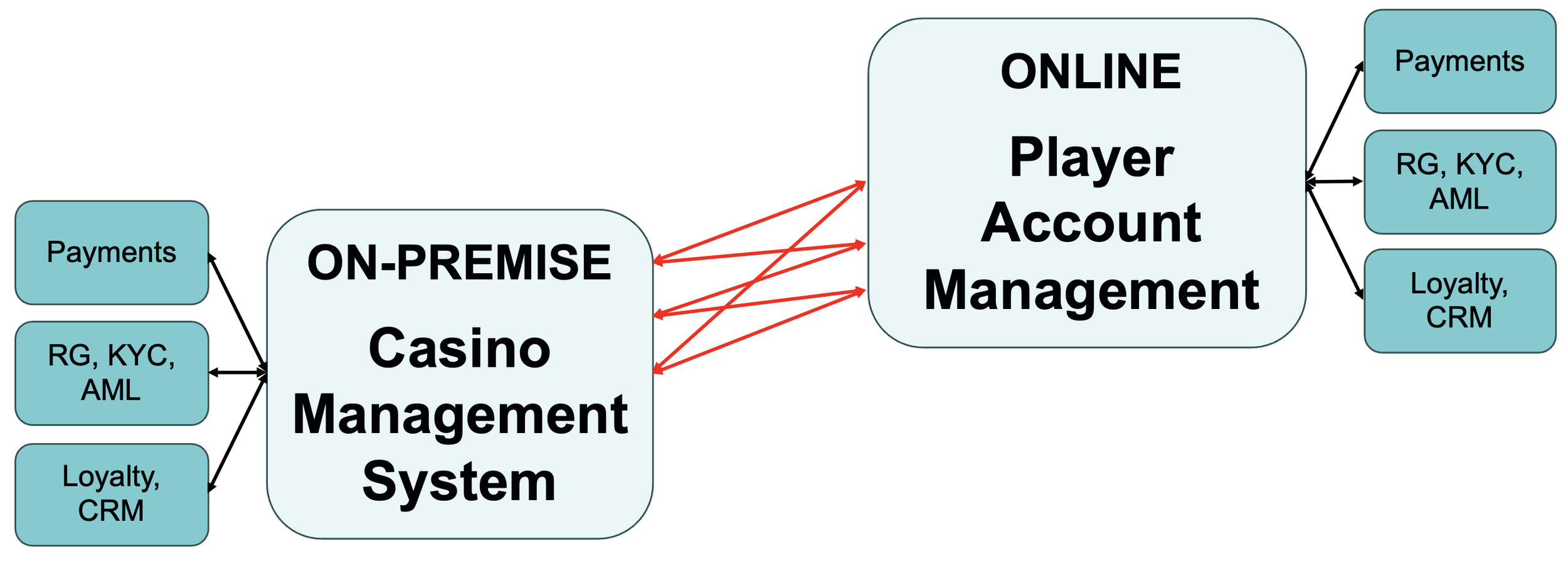
This solution again breaks the nature of the existing platforms which have not been designed with this requirement in mind. So, increased time/cost/risk…
Generally, the system will not have been designed with the other systems domain in mind - i.e. an online system is not usually designed with physical casino’s in mind. Therefore, additional functionality is required in that system to allow it to understand the other domain.
To create a fully seamless solution, logically, all major functions would take place in the master, which would require moving more and more capability to that, which again is not its designed nature.
CRM MASTER
Given the normal marketing focus on OMNI projects, it almost makes sense to look towards CRM systems to drive an OMNI solution. If the level of functionality provided is all that is needed, then for some operators it could be a good fit. However, this imposes a limit that restricts the solution to this purpose and extending to cater for cross-channel registration, advanced marketing, bonus engine, compliance, payments etc would be a significant endeavour.
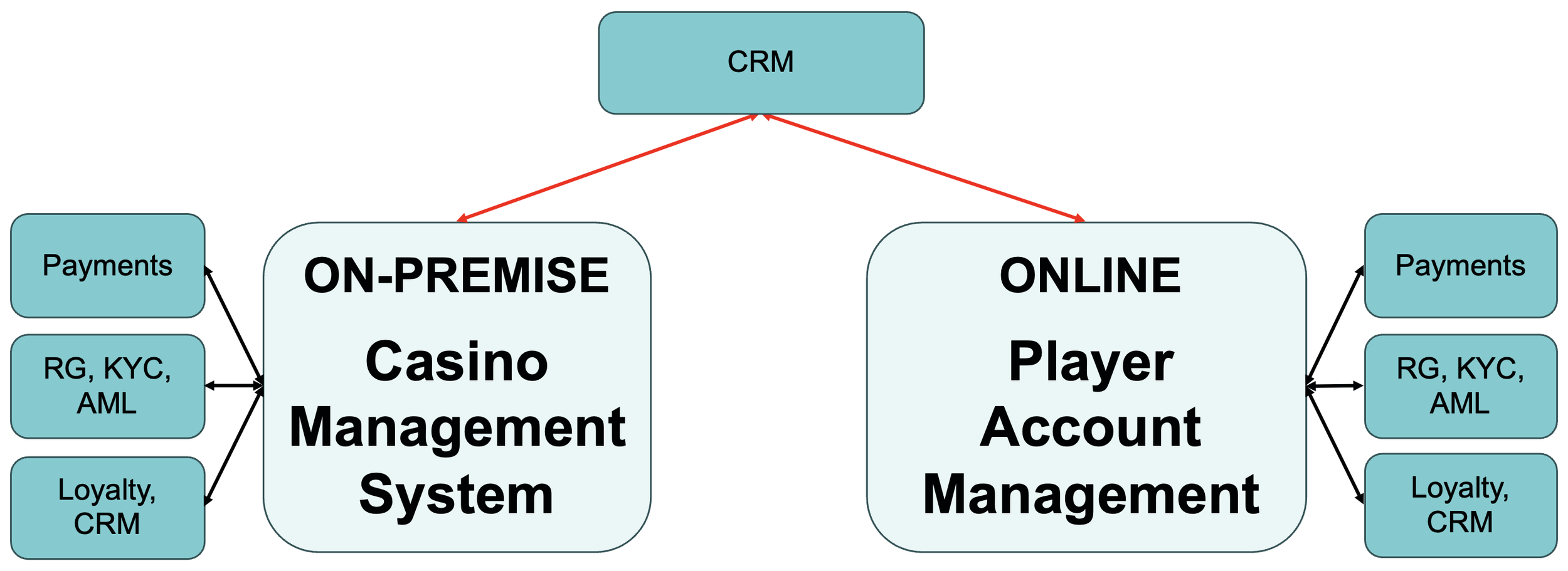
CRM systems do not typically have for example a flexible bonus engine that can deal with offering cross channel bonus, they rely instead on bonus engines linked to each system. The further the use-cases move from basic marketing, it becomes increasingly difficult to implement a seamless customer offering becomes. CRM systems do not deal with compliance, payments, risk, fraud etc.. And what about F&B/Hospitality - how would this be dealt with? All these areas ultimately need to be joined up centrally.
PRINCIPLES
FOCUS OF CHANGE
It is extremely challenging to try and alter an existing gaming solution to do something they were not designed to do when originally built. Examples of this are clear with the pain many organisations suffer when trying to deliver seemingly simple compliance changes, which to be fair were never considered in the day most gaming platforms had their genesis.
Therefore, a design principle must be to implement a solution which has the absolute minimum change required on existing systems and look to use existing API’s and 3rd party integration approaches to get data out and to execute required actions.
SEAMLESS = DO ONE THING ONCE
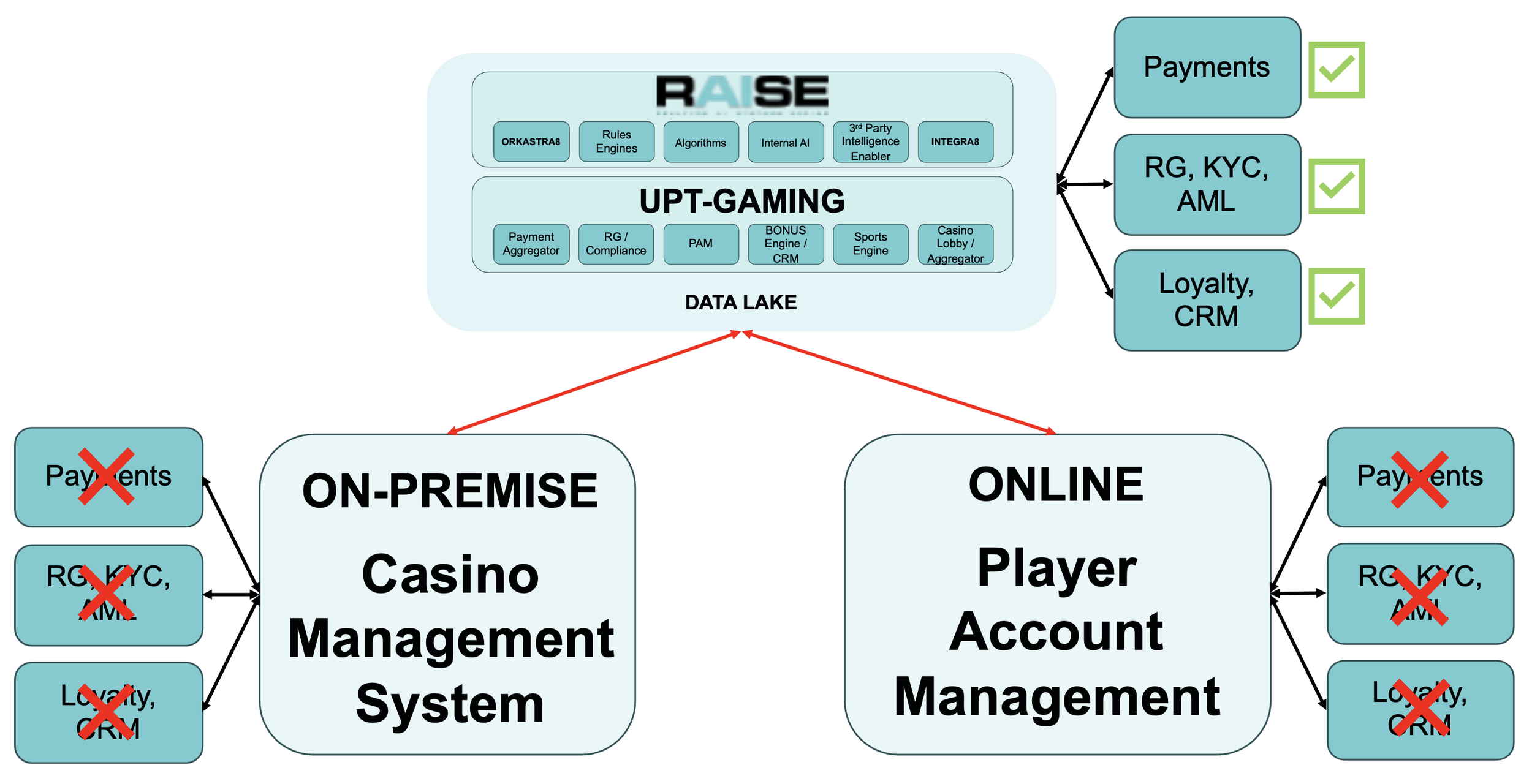
In the solution examples above each system will continue to do many things on its own without knowledge of what the other platform is doing. Each will have their own CRM solutions, payments, KYC, AML, Compliance, Products etc.. However, to get to a fully seamless offering, all customer activity must be considered and actions taken rapidly on holistic data. Therefore, duplication needs to stop, and therefore things are done once at the core (OMNI-MASTER) point, and leave the existing PAMs to focus on servicing customer transactions.
SOLUTION / CODE OWNERSHIP
The OMNI-MASTER solution for any organisation becomes very critical, as it weaves together all operational systems to offer a joined up offering to its customers. While replacing a retail or online PAM may be very difficult, replacing an OMNI solution is even more complex as it covers an even wider area of business. Therefore, of any area that an organisation should own and internalise it is that of OMNI. The rights to acquire the source code of its solution is critical. Once an effective OMNI MASTER solution is in place it makes changing one of the other components (e.g. Online PAM) far lower risk - offering advanced migration options, and even ability to run dual/multiple systems.
UPT SOLUTION
What does UPT provide to solve this problem?
We provide an industry agnostic middleware layer that sits on top of your systems (RAISE), integrating to your on-premise and online PAM’s, plus whatever other systems required. Critically, this is supported by our extensive library of integrations (payments, KYC, AML, Sports, Casino etc) and our Gaming services to establish a core solution which can achieve the typical short-term objectives of coordinated registration, and simple marketing. Yet it also via its ‘Persona’ functionality creates a single-view of the customer and establishes a master account - linked to accounts in all other systems.
This is unique in the gaming industry, and without it companies either must build the entire solution from scratch or even worse try and use an existing PAM as master. The solutions that are proven successfully in the sector are typically internally developed middleware solutions, which have taken significant time and investment to deliver. Using an existing PAM instead usually results in failure, as it breaks the principles, is too rigid in its design and the time/cost to change if even possible would be far too high.
The UPT middleware creates a conduit to flow all operational data into your chosen data store, including the data it creates itself, including MDM elements such as master account.
Over time though, the real benefit is the ability to move functionality that exists separately in each PAM (retail & online) into the core. Driving simplicity over time -
The PAMs get to stick as close to their nature as possible, with the OMNI-MASTER almost being transparent to them.
So, not only can basic marketing take place, but CRM can be done at the OMNI-MASTER level with actions driven out accordingly.
The same is true for compliance, so that real-time joined up action can be taken in response to all customer activity.
Again, the same for payments, where this can be moved to the core, or, based on whatever rules the operators wish, it can offer a way for funds to move between channels as required.
Advanced marketing can be driven through the UPT orchestration layer (ORKASTRA8), and by using some of our gaming services like Bonus. Bonus is a highly advanced engine, which is programmatic in nature - allowing entirely custom bonus creation using triggers and inputs from whatever system, tracking progress and executing required outcomes.
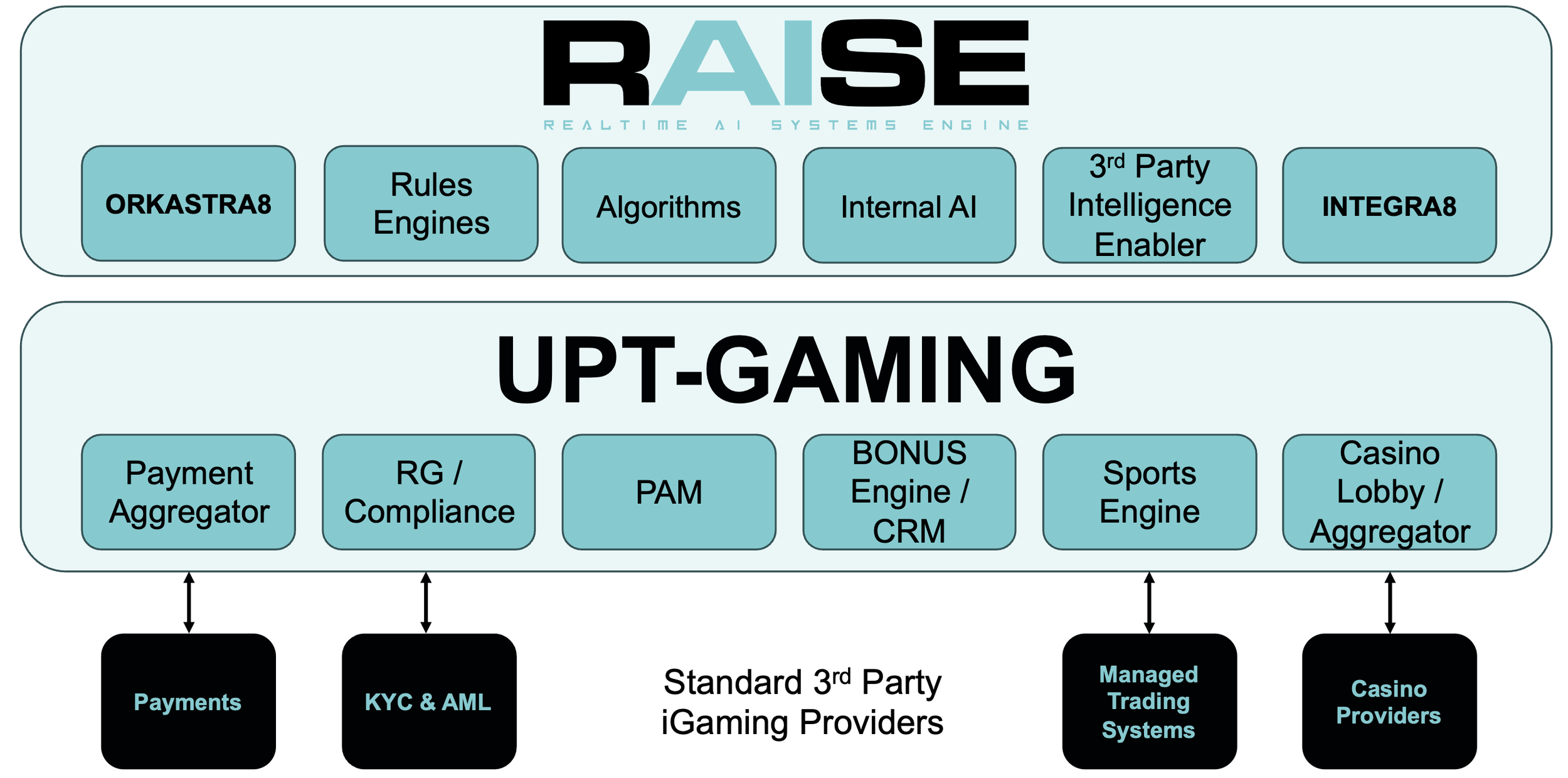
What is RAISE & UPT-GAMING?
RAISE, which is essentially middleware for gaming (albeit industry agnostic), can satisfy an unlimited set of use cases in real-time for both internal and external facing functions. It is constructed of 2 distinct elements -
INTEGRA8 - which deals with integration with all touch points. We have decades of experience in implementing gaming integrations in retail and online systems. Integration effort is reduced for target systems as we understand how they work in terms of payments, CRM, KYC, AML, etc - and we can leverage those integration types to provide hooks and triggers into systems without creating everything from scratch.
ORKASTRA8 implements and manages your business processes and customer interaction. - our low-code workflow implementation and automation. Enables anything from simple rules, through to complex algorithms, to AI.
Provides instant data access for informed decision making for whatever operational reason - marketing, compliance, payments etc..
UPT-GAMING is a set of services when combined that provide:
Payment Aggregator
Player Account Management (PAM)
Programmatic Bonus Engine
CRM
Compliance & Responsible Gaming
Casino Lobby & Aggregator
Sports Betting Engine
Recommendation Engine
This results in the following typical B2C architecture:
IMPLEMENTATION APPROACH
The OMNI-MASTER core is implemented and inbound/outbound integrations completed against target systems. This is hosted within operators chosen environment, which can be Cloud (solution is entirely agnostic), Hybrid or on physical tin.
MDM/Persona rules setup in ORKASTRA8 based on operators’ business rules.
Data output established into chosen data store - data lake etc…
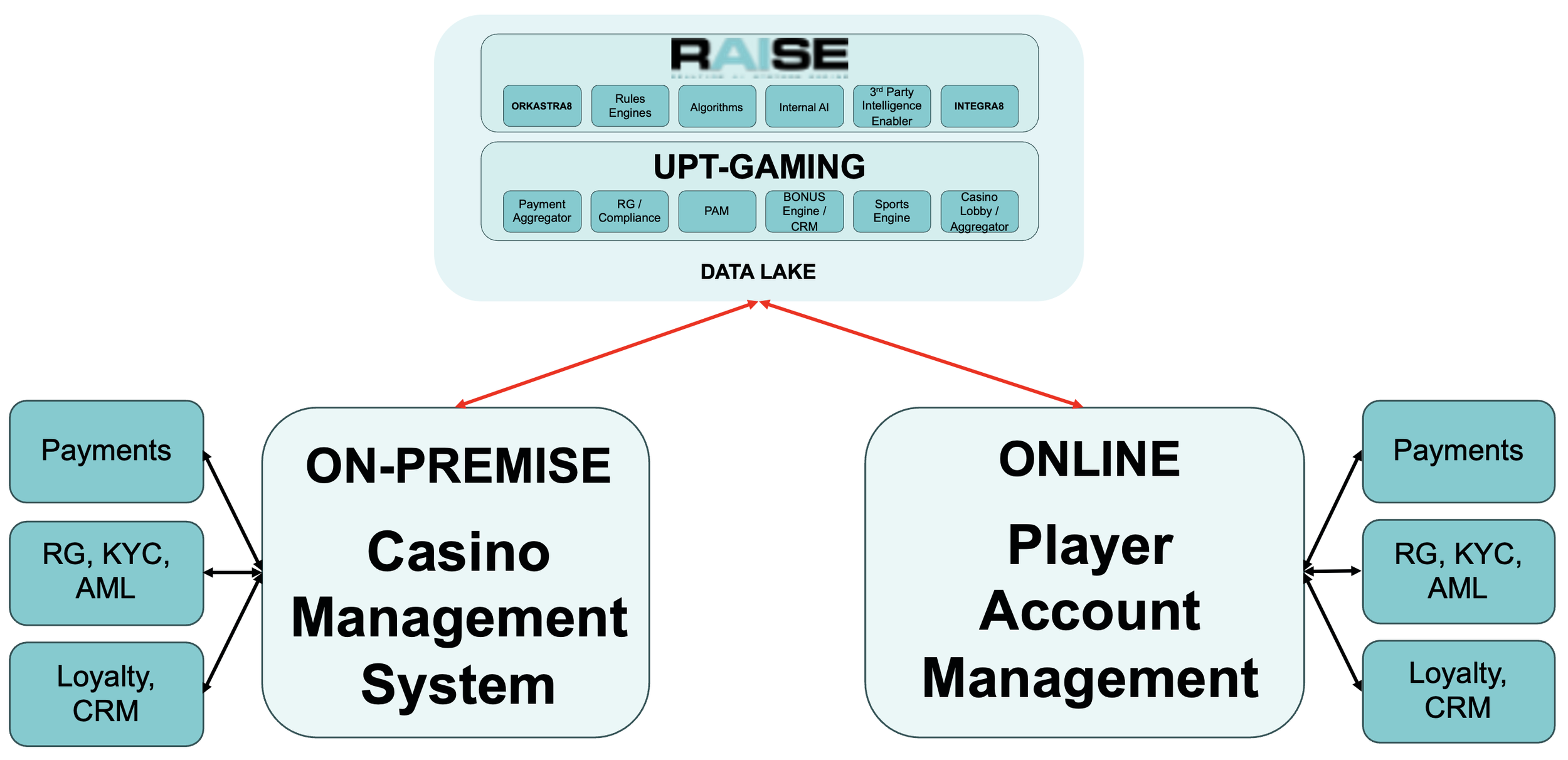
Depending on the organisation’s priority, tackle each area of functionality in turn or in parallel. And of course, an organisation may choose for their own reasons not to tackle some areas at all:
Registration harmonisation
Basic Marketing
Moving CRM etc to core and offering advanced cross-channel dynamic custom real-time bonus etc
Moving Compliance to the core and offering real-time response to all customer activity
Moving payments to the core, or, allow funds movement between channels based on the organisation’s rules. as an example, we can in effect become a ‘payment-type’ as far as existing solutions are concerned, and offer a payment out of one, and payment into the other as required.
So, the diagram above changes, reflecting that things are done once and at the MASTER level, delivering a true seamless experience:
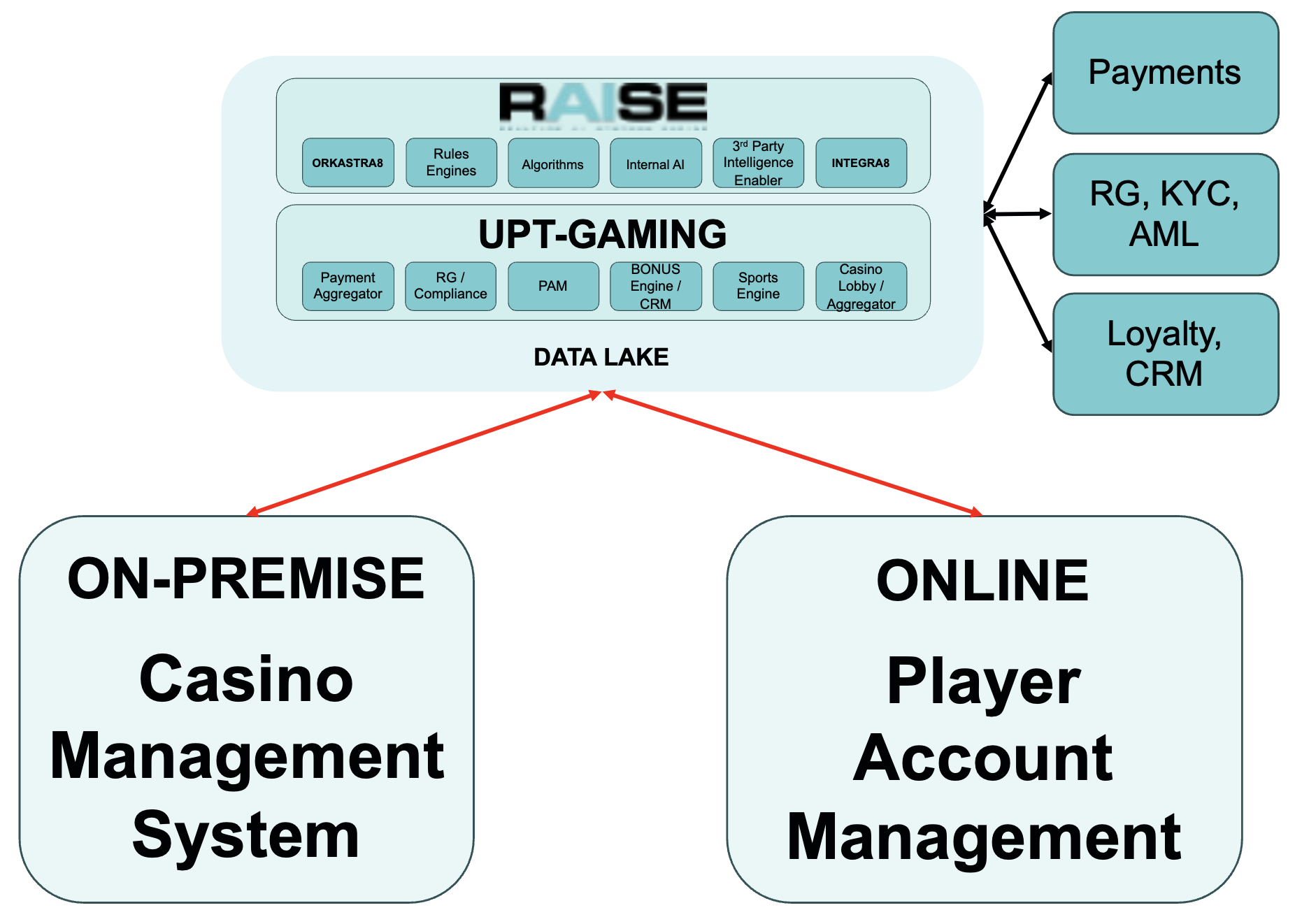
To ultimately become:
This caters for non-gaming related business operations areas such as F&B and Hospitality:
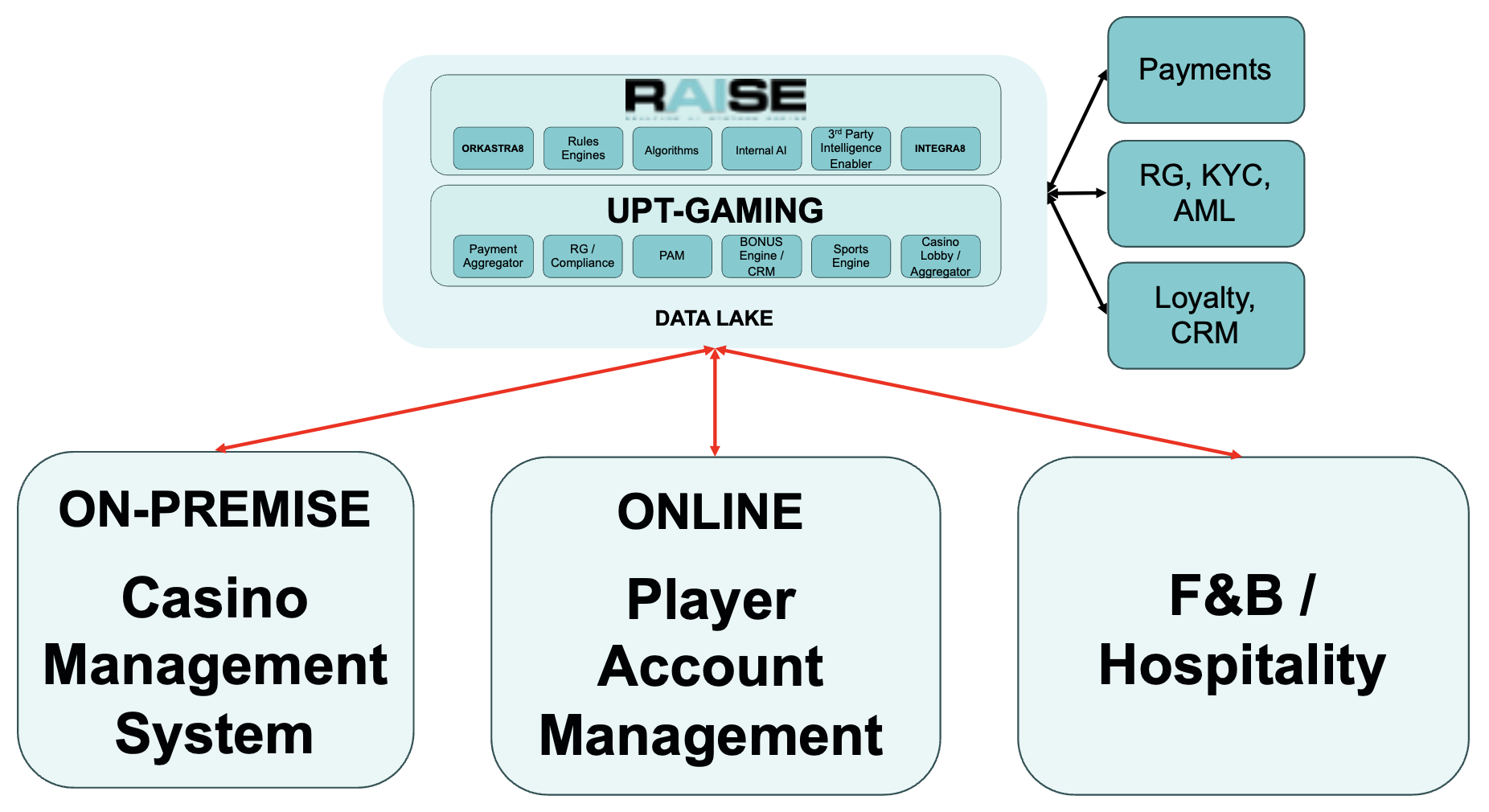
This approach provides the long-term architecture to get to a fully seamless OMNI solution, while allowing an operator to move at their own pace in terms which areas they want to tackle and when. Given this, it is also worth noting that the solution is an excellent candidate for bringing a wayward OMNI project back on course - the same progressive approach is applicable.